
Does Trauma Cause ADHD? The Link Between Adult ADHD and Childhood Trauma
ADHD and trauma can look a lot alike. Both can affect your focus, emotional regulation, memory, and sleep. Because of this, many adults start to wonder whether their ADHD was actually caused by trauma — especially if they grew up in an abusive environment.
The answer is complicated. Trauma doesn’t directly cause ADHD, and that's important to recognize. But childhood trauma and ADHD are closely connected, and trauma can absolutely make ADHD symptoms harder to manage. Trauma can also create symptoms that look like ADHD, which is one reason it’s so important to get a comprehensive assessment instead of trying to figure it out on your own.
Can trauma cause ADHD?
According to research, trauma is not a direct cause of ADHD. ADHD doesn't have a single cause, but risk factors include:
- Genetics (studies show that it's up to 80% hereditary)
- Maternal smoking or drinking while you were in the womb
- Low birth weight
- Lead exposure early in life
- Traumatic brain injury as an infant or young child
But that doesn't mean that there is no link whatsoever between trauma and ADHD. Childhood trauma, in particular, has been highly linked to ADHD. There are a lot of explanations for this, but some studies have found that early childhood trauma can increase your risk of developing ADHD. Going through trauma may also make your ADHD symptoms worse if you already live with it.
ADHD is a neurodevelopmental condition, not a trauma response.
ADHD is a neurodevelopmental condition, which means it's an early childhood disorder that affects (and is affected by) the way your brain developed in the early years of your life. To be diagnosed with ADHD, you must have experienced symptoms before the age of 12.
That means that you can't experience a traumatic event later on in life (in adolescence or adulthood) and suddenly develop ADHD, no matter how severe the trauma was. If you feel like this has been your experience, there are a few different explanations:
- You did have ADHD symptoms as a child --- you just weren't accurately diagnosed.
- Trauma can mimic ADHD symptoms, although they're not the same thing.
The link between adult ADHD and childhood trauma
Although trauma isn't a direct cause of ADHD, research has shown that there is a strong link between the two. People who went through adverse childhood experiences, like abuse, neglect, or witnessing violence in the home, are more likely to live with ADHD. The more frequent or severe the trauma, the higher the risk of ADHD.
This doesn't mean that ADHD is caused by trauma. Some studies show that children with ADHD are more likely to be exposed to trauma, like being the victim of maltreatment from their caregivers.
ADHD often causes behavioral symptoms in children like [brief list]. Some caregivers may find these symptoms stressful and difficult to manage, which can lead to a higher risk of abuse.
Some studies have found that children who have experienced trauma are more likely to develop ADHD later on. It's possible that experiencing trauma in early childhood can change the way your brain develops.
We still don't have enough evidence to be able to say which direction the relationship goes --- if ADHD is caused by trauma or vice versa. It's a complex question, and one that we need more research on.
PTSD symptoms that may get mistaken for ADHD
Sometimes, when people feel they've developed ADHD as a result of a traumatic experience, they're actually experiencing PTSD symptoms that look like ADHD. Although they're different conditions, there is some overlap in symptoms.
You may be misdiagnosed with ADHD (as a child or as an adult) when what you're really experiencing are the effects of trauma.
Symptoms of ADHD
Symptoms of ADHD can include:
- Difficulty paying attention, especially during tasks that feel boring or repetitive
- Forgetfulness or losing things
- Overlooking details and making careless mistakes
- Difficulty starting tasks or finishing them
- Restlessness or fidgeting
- Impulsivity, like interrupting people or making decisions without thinking them through
- Trouble with organization and time management
- Emotional dysregulation, including irritability or intense reactions
Signs of trauma
Signs of trauma can include:
- Feeling constantly on edge or alert to danger
- Difficulty concentrating because your brain is scanning for threats
- Sleep problems like insomnia or nightmares
- Emotional numbness or feeling disconnected from your body
- Intense emotional reactions, especially to reminders of what happened
- Avoidance of certain places, people, conversations, or memories
- Low self-worth, shame, or guilt related to the trauma
- Trouble trusting other people or feeling safe in relationships
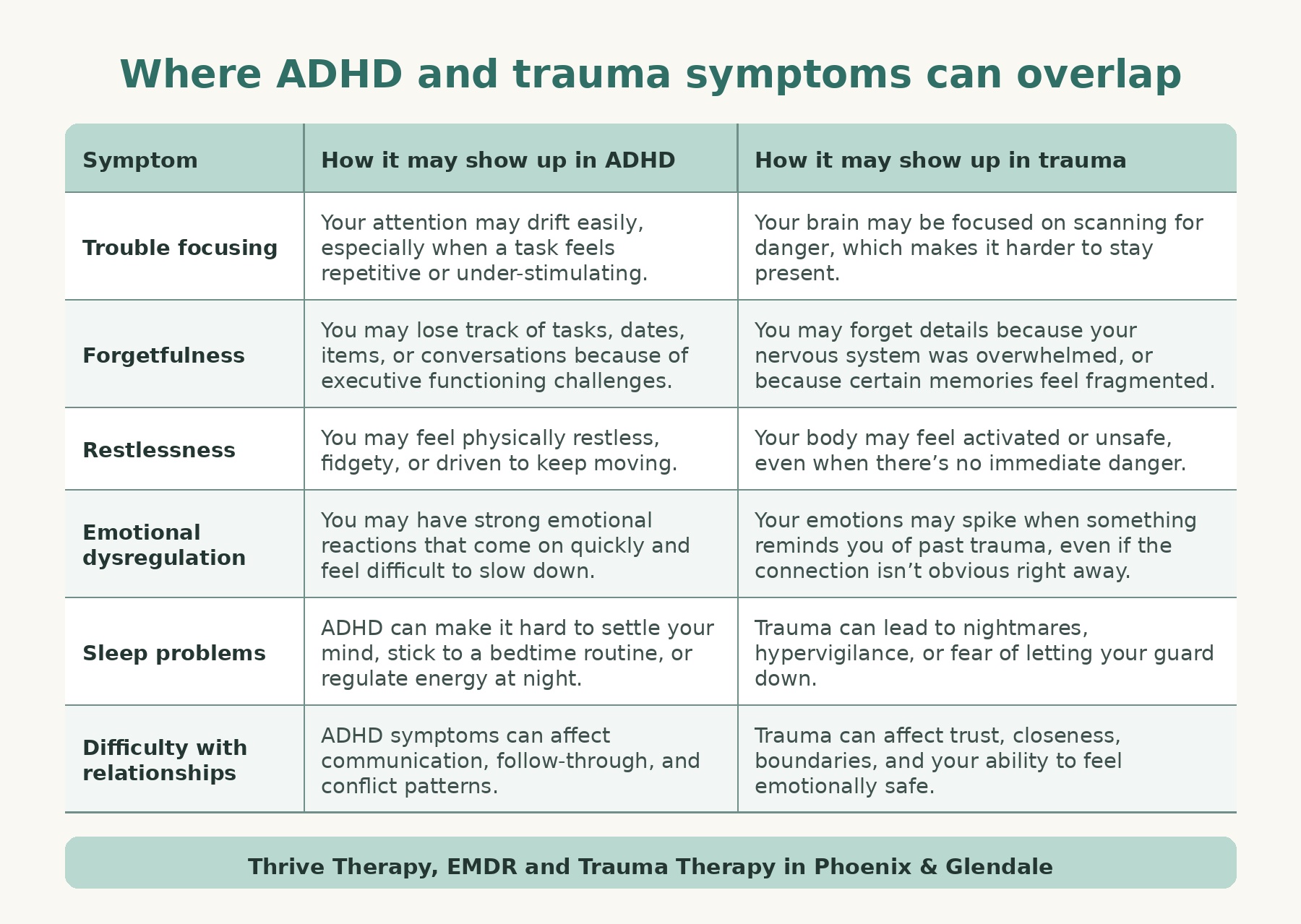
Where there's overlap between ADHD and trauma
On paper, it's clear how trauma and ADHD are different. But there is actually a lot of overlap when you look at how these symptoms present in real life.
Start trauma therapy and EMDR therapy in Phoenix and Glendale, AZ
If you’re trying to understand how much of your current experiences and symptoms are related to past trauma, you don’t have to figure that out on your own. It's hard to know exactly what's going on, and we're here to help you navigate this.
At Thrive Therapy, we offer trauma treatment in Phoenix and Glendale, with online therapy available throughout Arizona. Many of our therapists are trained in EMDR, an evidence-based method for treating trauma and PTSD. You can also participate in 3-hour EMDR intensive sessions if you need more support.
Eye movement desensitization and reprocessing (EMDR) therapy can help you process traumatic memories without having to talk through every detail. If trauma is causing ADHD-like symptoms --- and affecting your focus, relationships, sleep, or emotional regulation --- EMDR may help your nervous system get out of survival mode.
Get in touch with us to get matched with a trauma therapist in Arizona today.
Medically reviewed by: Colter Bloxom, LPC
Colter is a licensed psychotherapist and the owner and Executive Director of Thrive Therapy. He specializes in the treatment of anxiety, OCD, identity issues, and more.


