
OCD and Suicidal Thoughts: Is This Suicidal OCD? Or Are You Experiencing Suicidal Ideation?
Written by Colter Bloxom, LPC
Colter is a licensed psychotherapist and the owner and Executive Director of Thrive Therapy. He specializes in the treatment of anxiety, OCD, identity issues, and more.
OCD and suicidal thoughts have a deeply interwoven relationship. If you live with obsessive-compulsive disorder, then you may have had thoughts about suicide at some point or another. Maybe your symptoms became so painful and scary that you had a thought: “I hope I don’t wake up in the morning so I don’t ever have to deal with this again.”
Or maybe you found yourself worrying that you’ll hurt yourself, even if you actually want to live. You don’t think you want to kill yourself, but what if you do anyway? This thought may have caused you to do things like hide all the knives in your home.
Here, I’m going deep into the relationship between OCD and suicidal thoughts, including how to differentiate between “true” suicidal thoughts and OCD obsessions.
If you’re having thoughts about suicide, or if you feel like you might hurt yourself, this article isn’t a substitute for immediate care. If you’re in the U.S., you can call or text 988 to reach the Suicide and Crisis Lifeline, which is available 24/7. If you’re outside the U.S., local emergency services or crisis lines can help connect you to support right away.
The link between OCD and suicidal ideation / self-harm
OCD and suicidal thoughts are connected in so many deep and complex ways.
First of all, it’s important to discuss how OCD can and does lead to “true” suicidal thoughts. I don’t like to call them “true,” because it’s all real, especially when you’re the one experiencing them. But when I say “real” or "true" thoughts, I mean that you’re truly experiencing suicidal ideation — a desire to end your life. These aren’t intrusive OCD thoughts, which I’ll explain later.
Research shows that living with OCD significantly raises your risk of experiencing suicidal ideation. One review found that nearly 15% of people who live with OCD attempt suicide at least once in their lives. Up to 3 in 4 people with OCD report having suicidal thoughts. This compares to only around 5% of the general population who have suicidal thoughts.
Self-harm isn’t usually a suicidal behavior, but they’re linked in some ways. This refers to anything you might do to intentionally hurt yourself, including cutting your skin or pinching yourself. Self-harm is also common in people with OCD. Around 7% of people with OCD engage in self-harm of some kind.
So what explains this link? One major reason for this overlap is that OCD often co-occurs with depression and other anxiety disorders. Living with obsessive-compulsive disorder can be exhausting. The constant cycle of obsession, anxiety, and compulsions can wear people down over time.
When symptoms feel unrelenting, hopelessness can set in, which increases the risk of suicidal ideation and attempts. OCD may also increase sensitivity to distress and uncertainty, which can make intrusive thoughts about harm or death feel even more overwhelming.
Symptoms of suicidal OCD
But you can also experience OCD obsessions about suicide, which can make things even more confusing. OCD can start revolving around any topic, especially topics that are important to you.
“Suicidal OCD” isn’t an official subtype of OCD (there are no official subtypes of OCD), but it’s a common obsession theme.
If you experience “suicidal OCD,” you might have thoughts (obsessions) like:
- What if I picked up this knife right now and stabbed myself to death with it?
- What if I suddenly lose control and jump in front of traffic?
- What if this feeling of exhaustion means I secretly want to die?
- What if thinking about suicide means I’m dangerous to myself?
- What if I act on these thoughts even though I don’t want to?
The other part of OCD is compulsions. This is how you try to calm your fears or prevent them from coming true. Compulsive behaviors can happen mentally or physically. Some examples include:
- Hiding all sharp objects in your home
- Mentally reviewing your thoughts over and over to “check” whether or not you’re suicidal
- Asking others for reassurance that you’re not at risk of suicide
- Avoiding certain places, objects, or situations that trigger suicidal OCD thoughts
- Repeatedly researching suicide online and reading about others’ experiences to “make sure” you wouldn’t actually do it
How to differentiate between "real" suicidal thoughts and OCD symptoms
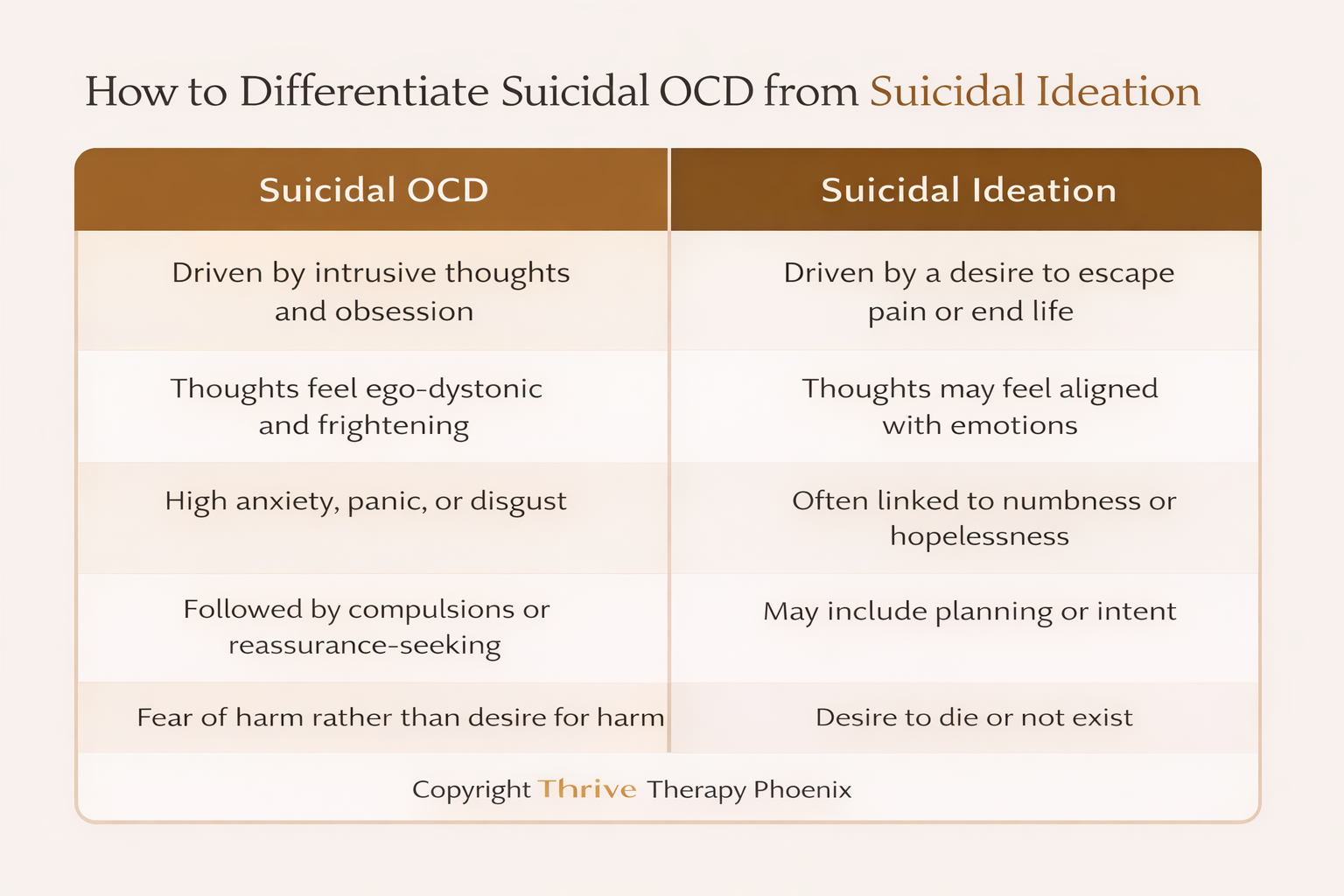
If you’re having obsessive thoughts about suicide, they feel true — just like any obsession feels true. OCD is known as an ego-dystonic condition, which means that these thoughts are opposite to who you are (or who you want to be). That’s why they feel so scary.
With OCD, the brain sends out false danger signals. An intrusive suicidal thought isn’t a wish — it’s an unwanted mental event that clashes with your values. Because the thought feels urgent and emotionally charged, your brain treats it as meaningful, even though it’s not. The more you try to analyze or seek reassurance about the thought, the stronger and more obsessive it can become.
This is why suicidal OCD can feel indistinguishable from real ideation in the moment. It feels so real.
There’s no way that I can tell you if the specific thoughts you’re having right now are obsessions or real suicidal thoughts. And if you feel like you might hurt yourself, regardless of the reason, then seek emergency care right away. Call emergency services, go to the nearest emergency room, or contact the Suicide and Crisis Lifeline at 988.
But generally, here are some things to think about:
- Are your thoughts starting with “What if?” OCD obsessions tend to start with these words.
- Do the thoughts bring you dread, shame, or fear? Or do they bring a sense of relief?
- Do you feel an urge to do compulsive behaviors to reduce anxiety or get certainty? Are you trying to “figure out” what your thoughts mean?
- Do the thoughts feel intrusive, unwanted, and disturbing rather than intentional?
- Do you spend hours analyzing what the thought “means”?
- Does reassurance help briefly, then make the thoughts come back stronger?
Seeking treatment for suicidal OCD and intrusive thoughts
Regardless of where your suicidal thoughts are coming from, there is hope. OCD — as well as any co-occurring conditions like depression — can be successfully treated. Almost everyone with OCD feels better after the right treatment.
Exposure and response prevention (ERP)
The “gold standard” in OCD treatment is a type of cognitive-behavioral therapy called exposure and response prevention, or ERP. ERP helps you face intrusive thoughts and fears without performing compulsive behaviors or response prevention rituals. Over time, this retrains your brain to tolerate uncertainty and distress without escalating anxiety. For suicidal OCD, ERP focuses on reducing fear around suicidal thoughts rather than trying to prove you’re safe.
Intensive outpatient program (IOP) for OCD
Some people also choose to go into more intensive forms of therapy to deal with OCD. This doesn’t necessarily mean you need to go into inpatient. An intensive outpatient program (IOP) can provide structured, evidence-based treatment multiple days per week while still allowing you to live at home. OCD IOPs often combine ERP with other therapy methods and psychiatric care, which can be especially helpful if OCD feels hard to manage in weekly therapy alone.
Reach out to OCD therapists in Phoenix, AZ
If you’re living with OCD — including experiencing suicidal OCD or intrusive thoughts about harm or suicide — Thrive Therapy offers specialized OCD treatment in Phoenix. We specialize in individual intensive OCD therapy and also have an intensive outpatient program (IOP) specifically for OCD.
Get in touch with us today! We can give you more information about our OCD treatment programs and help you get matched with the right therapist.


